
- Home
- Antimony Assets
Antimony Assets
Nova's antimony assets have the potential to help secure a U.S. domestic supply chain for the strategic mineral in the near term
Overview
Critical U.S. Supply Chain Asset
The discovery of high-grade surface samples of stibnite, the primary ore source for the critical mineral antimony, across multiple prospects within the Estelle project area has led independent resources expert RFC Ambrian to recognize it as one of just nine potentially viable near-term antimony projects globally.
With several of these prospects now drill ready and the significant interest shown in Estelle’s antimony potential, Nova plans to commence drilling gold-antimony-rich targets in 2025, with the goal of establishing an initial mineral resource estimate for antimony.
Why Antimony Matters
Antimony is needed for defense, energy storage, and electronics
The U.S. is 100% reliant on foreign imports, primarily from China and Russia, and China has banned all exports of the critical mineral
Designated as a critical mineral by the U.S government, with urgency to secure domestic production
High-Grade Antimony Discovery at Estelle
prospects with antimony in surface sample results have been identified across Estelle to date
samples grading > 1% antimony
Stibium and Styx prospects the highest priority with samples up to 60.5% Sb among the highest globally
Strategic U.S. Supply Chain Opportunity
Opportunity for Nova to develop a fully secured and integrated U.S. domestic antimony supply chain in Alaska, from mining to a refined product
Advanced discussions underway with the U.S Department of Defense to potentially secure funding to fast-track Estelle’s antimony assets
Early stage development of a stand-alone low CAPEX mine at Stibium being investigated for potential near-term production
Potential fast-tracked permitting due to strategic importance
Antimony prices have surged and the future price outlook remains strong due to supply chain risks and global demand growth
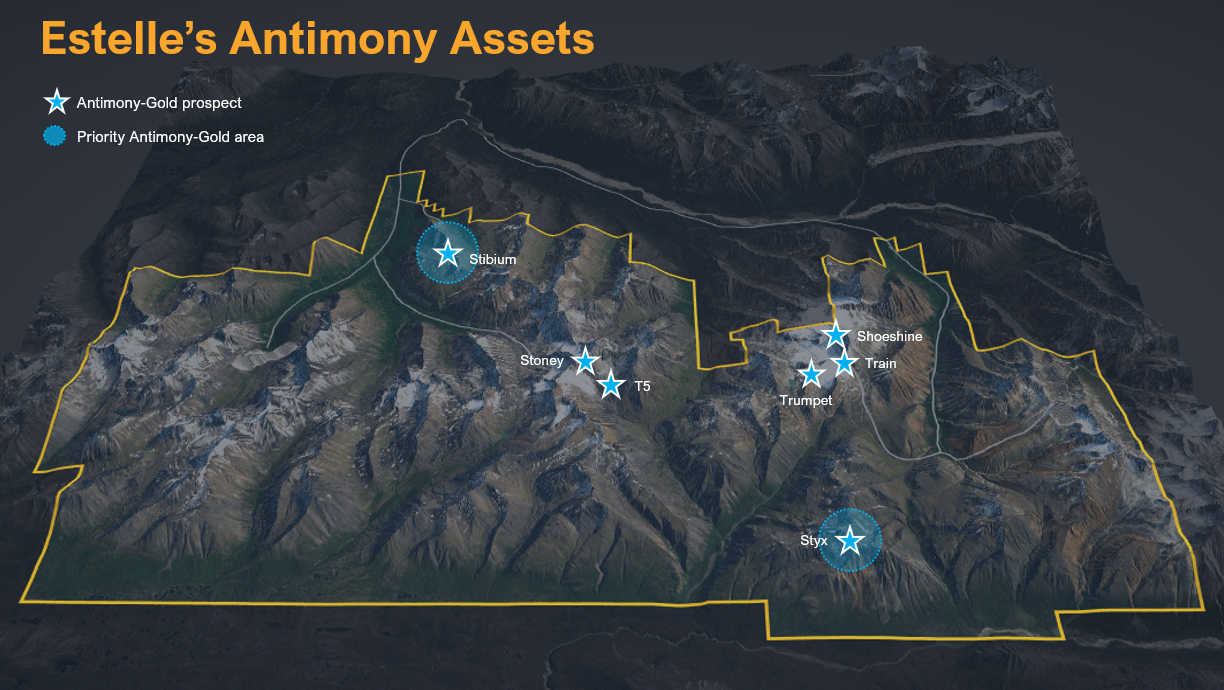
To learn more about Estelle’s antimony assets, please hover over the star hotspots marked on the map above.
Stibium
Near Term Antimony Potential
The Stibium prospect, located in close proximity to Korbel and the camp, is defined as a large antimony-gold rich zone, 800 meters long and 400 meters wide, which remains open along strike, based on extensive surface exploration sampling of rocks and soils.
The mineralized system is characterized by intrusion-related gold and antimony bearing quartz veins, including a 2m wide outcropping containing Stibnite over a 30m strike length.
12 rock samples > 30% Sb with a high of 60.5% Sb
10 soil samples > 0.1% Sb with a high of 2.8% Sb
16 rock samples > 5 g/t Au with a high of 141 g/t Au
35 soil samples > 1 g/t Au with a high of 25.6 g/t Au
Stibium is considered Estelle’s top priority antimony asset, with drilling set to begin in 2025 to potentially establish a maiden resource of both antimony and gold at the prospect.
Styx
More High-Grade Gold-Antimony Mineralization
The Styx prospect, is characterized by a color anomaly near the Styx river. The main occurrence at the prospect is a ~1m thick quartz-stibnite vein (50% stibnite) with excellent outcrop exposure over 20m. Additional sampling of splays around this occurrence show the anomaly likely extends over a 150m strike length.
9 rock sample > 1% Sb with a high of 54.1% Sb
500kg bulk sample collected for metallurgical test work
The deposit, which has a very low strip ratio of 1.7:1, and selective mining potential, features a high-grade feeder core at surface that offers direct mill feed from a starter pit, while testing has shown the lower-grade material can be upgraded up to 6 g/t Au using ore sorting technology.
Other Antimony Prospects
Further Anomalous Gold-Antimony Mineralization
Further anomalous gold-antimony mineralization has been discovered at the Train, Trumpet, Shoeshine, Stoney, and T5 prospects.
Train: 5 rock samples > 0.1% Sb with a high of 2.1% Sb
Trumpet: 12 rock samples > 0.5% Sb with a high of 16.8% Sb
Shoeshine: 3 rock samples > 0.1% Sb with a high of 0.9% Sb
Stoney: 5 rock samples > 1% Sb with a high of 2.5% Sb
T5: 9 rock samples > 0.1% Sb with a high of 0.5% Sb