
- Home
- Estelle Project
Estelle Project
Nova is rapidly advancing Estelle, one of the world’s largest undeveloped gold assets, with the added potential for near-term antimony production
Overview
World Class Asset - District Scale Gold and Critical Minerals
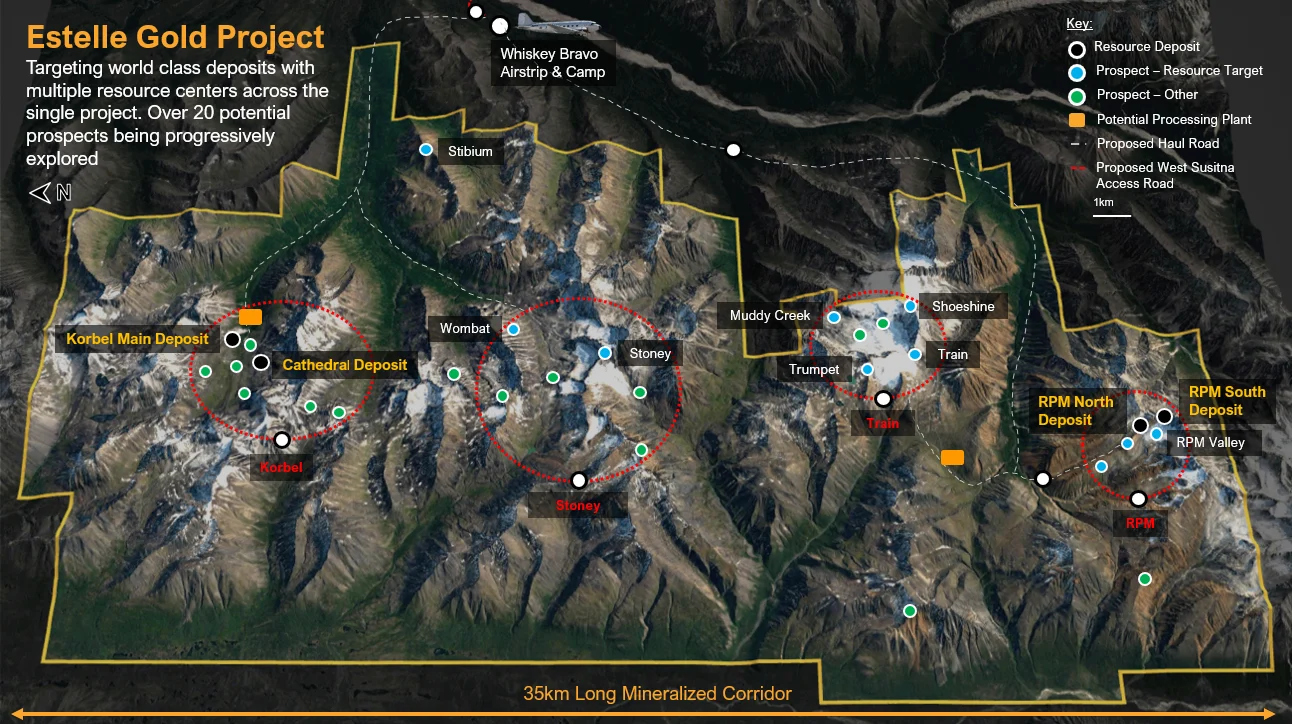
The district scale Estelle Project ranks among the world’s largest undeveloped gold assets. Spanning a 35 km-long mineralized corridor, it hosts more than 20 identified gold prospects, including four large, near-surface, intrusion-related gold deposits. These deposits, which remain open with thick ore zones from surface and a low strip ratio, amendable to large scale bulk mining using conventional truck and shovel methods, currently contain a global JORC-compliant measured, indicated, and inferred resource of 9.9 million ounces of gold, and a S-K 1300 pit-constrained resource at a US$2,000 oz gold price of 5.2 million ounces gold, with further drilling planned.
The Project is a year-round operation located 150 km northwest of Anchorage, covering 514 km² of mining-friendly State of Alaska public lands within the Tintina Gold Belt, a region known to hold over 220 million ounces of primarily bulk-tonnage, high-margin gold deposits, including some of the world’s largest gold mines and discoveries, such as Kinross Gold Corporation’s Fort Knox Gold Mine.
In addition to its gold endowment, the Tintina Gold Belt is known for significant antimony mineralisation and was historically an important source of North American antimony production. At Estelle, Nova has identified antimony and other critical minerals associated with gold mineralisation across multiple prospects through surface sampling programs.
Supported by a US$43.4 million award from the U.S. Department of War to help develop a domestic antimony supply chain, Nova is accelerating its critical minerals strategy and targeting initial antimony production in late 2026 to 2027.
Our Location
Mining Friendly Alaska
Tier 1 Mining Region with Infrastructure Solutions in Place
The Estelle Project, located on State of Alaska public lands approximately 150 km (93 miles) northwest of the major US city of Anchorage, is a year-round operation, near a large labour force and all essential services. The base site hosts a fully winterized 80-person camp, including an on-site sample processing facility and the 4,000-foot Whiskey Bravo airstrip, which can facilitate large capacity DC3 type aircraft.
Multiple power supply options are being evaluated for the project as part of the PFS trade-off studies currently underway, including the potential for power transmission lines to feed into the State electricity grid, an offtake from the proposed Donlin gas pipeline which runs 10-15 miles north of the site, and diesel generators on site.
West Susitna Access Road Progresses to Permitting
While easy access is currently available to the project via a winter road and by air, the proposed all weather West Susitna Access Road, which is situated entirely on State land within the Matanuska-Susitna Borough and which has considerable support from both the community and the State government (see Alaska Department of Transportation and Public Facilities website here), has progressed to the permitting stage. The EIS process is currently underway and construction of the road is proposed to start in 2026.
Alaska Governor, Mike Dunleavy: “The West Susitna Road is important for local residents and gaining fair access to hunting, fishing, and potential jobs. My administration is constantly looking at ways to grow our economy and this project is a great opportunity for not only south-central Alaska but the entire state. I am committed to this project and unlocking resources that benefit all Alaskans.“
To view the full press release from the Alaska Industrial Development and Export Authority (AIDEA) click here
Interactive Map
To learn more about the Estelle Project, please hover over the hotspots marked on the map below.
Resource & Drilling
The Estelle Project currently comprises of 4 gold resource deposits across 2 main areas
Korbel Gold - 2 large bulk tonnage resources
Korbel Main, a bulk tonnage gold deposit, located in the North of the project area, which has a confirmed strike length of over 2.5km and up to 500m depth, and remains open with significant potential to further extend the mineralization.
Cathedral is another bulk tonnage gold deposit nearby and similar to Korbel Main. An initial maiden Inferred resource has confirmed a strike length of at least 800m and 350m wide. The deposit remains wide open in all directions. The potential for high-grade zones exist with up to 114 g/t Au in surface rock chip samples.
RPM Gold - Geological evidence suggests the 3 RPM areas may be genetically linked
RPM North is a high-grade gold deposit, located in the South of the project area, which has a 450m strike length and 150m width, defined by close spaced resource drilling, and remains open. It also includes a high-grade M&I core of 100m long x 50m wide x 300m deep. Significant potential remains to further extend the mineralization.
RPM South is a newly discovered gold zone. Initial drilling as confirmed a genetically link to RPM North. Currently resources have a strike length of 400m and 250m width. Over 600m of perspective strike length connects RPM South with RPM North.
RPM Valley is another newly discovered gold mineralized zone in the valley down from RPM North..
Antimony
Recently the Company has also discovered antimony and other critical minerals coincident with the gold in surface sampling on numerous prospects across the project. Drilling commenced at the Stibium prospect in late 2025 and is expected to be completed in 2026.
Drilling
84,000m of diamond and RC drilling has been undertaken to test the extent of all deposits and infill, in support of a high confidence JORC compliant gold Mineral Resource Estimate of 9.9 Moz Au, and a S-K 1300 pit-constrained resource at a US$2,000 oz gold price of 5.2 Moz Au across the Estelle Project, as detailed in the tables below. This Mineral Resource contains a proportion of Measured and Indicated classified material to support future economic studies and an Ore Reserve.
7,100m of drilling undertaken in late 2023 and 2024 is not included in the current MRE.
Drilling in 2025 plans to focus on further growing and proving up the measured and indicated resource to ore reserves for the PFS at RPM, and drilling the Stibium prospect with the aim to define a maiden MRE for both gold and antimony.
Estelle Project: JORC Compliant Global Mineral Resource Estimate, April 2023

JORC compliant global gold resource as per ASX announcement “Estelle Global Gold MRE increases to 9.9 Moz Au” with an effective date of April 11, 2023.9.9 Moz refers to the measured, indicated, and inferred resources on a 100% basis, 85% attributable to Nova Minerals (8.4 Moz).
Estelle Project: S-K 1300 Compliant Pit-Constrained Mineral Resource Estimate, January 2024

Notes
Unless specifically stated, Nova has prepared its disclosures on this website in accordance with the requirements of the ASX Listing Rules and the securities laws in effect in Australia, which differ from the requirements of US securities laws. Terms relating to ore reserves and mineral resources on this website are defined in accordance with the Joint Ore Reserves Committee’s Australasian Code for Reporting of Mineral Resources and Ore Reserves (JORC Code). All references to resources are also on a 100% basis, of which 85% is attributable to Nova Minerals.
Investors outside Australia should note that while ore reserve and mineral resource estimates of the Company on this website comply with the JORC Code (such JORC Code-compliant ore reserves and mineral resources being “Ore Reserves” and “Mineral Resources” respectively), they may not comply with the relevant guidelines in other countries and, in particular, may not comply with (i) National Instrument 43-101 (Standards of Disclosure for Mineral Projects) of the Canadian Securities Administrators (the “Canadian NI 43-101 Standards”); or (ii) Item 1300 of Regulation S-K, which governs disclosures of mineral reserves in registration statements filed with the SEC. Information contained on this website describing mineral deposits may not be comparable to similar information made public by companies subject to the reporting and disclosure requirements of Canadian or US securities laws.
Geology & Mineralization
Outstanding Mineralization
Geology
Alaska is composed of a series of accreted allochthonous terranes separated by large strike slip faults. In the geologic past, these terranes were translated large distances to their present location along the margin of the Pacific plate during oblique convergence throughout the Phanerozoic, finally accumulating in Alaska. The Estelle property is contained within the larger Kahiltna basin on the flanks of the Wrangellia terrane and there are two dominant rock types within the claims:
- Estelle Plutonic Suite – an elongate granodiorite plutonic complex with minor quartz monzonite, biotite quartz monzonite, diorite, and gabbro
- Kahiltna Flysch Sediments – deformed pelitic sedimentary rocks and flysch.
The Kahiltna basin represents a displaced and slivered suture zone between Wrangellia and the paleo-North American margin and is composed dominantly of flysch, sandstone, shale, and limestone. The Estelle plutonic suite is compositionally zoned and is made up of a granite core transitioning to granodiorite, quartz monzonite, quartz monzodiorite, diorite, and lamprophyric mafic and ultramafic rocks.
Mineralization
Mineralization on the Estelle property is hosted within veins within the plutonic suite and occasionally within the hornfelsed sedimentary rocks immediately adjacent to intrusive bodies. The sedimentary sequence hosting the plutons is generally barren. Mineralized veins in the intrusive body commonly contain quartz, tourmaline, chalcopyrite, arsenopyrite, pyrrhotite, molybdenite, stibnite, and pyrite. Gold bearing veins are most associated with arsenopyrite but, the presence of unidentified tellurides or other sulfosalts cannot be ruled out. Tellurium and bismuth are strongly associated with gold and mineralized intervals often contain consistent ratios of Bi/Au or Te/Au. A statistical review shows that the highest correlation coefficients with gold are tellurium (0.92), bismuth (0.86), arsenic (0.085) and silver (0.66). Gold mineralization does not appear to be affected by the different intrusive phases of the plutons with mineralized veins occurring in most igneous rock types to varying degrees across the property. The veins themselves crosscut the igneous body suggesting the host rock (granodiorite) was cool enough to deform brittlely at the time of mineralization. Two styles of hydrothermal alteration are recognized: 1) argillic/phyllic; and 2) propylitic. The regional alteration covers elongate zones within the granitic phases of the Mount Estelle pluton.

The overall style of granitoid-related mineralization resembles the many intrusive-related gold deposits of the Tintina Gold Province including Pogo, Fort Knox, Dolphin, Gil, Dublin Gulch, Brewery Creek, Ryan Lode, and Donlin Creek. These are collectively characterized by close associations with bismuth, tellurium, and arsenic. Mineralization at Estelle is consistent with the reduced intrusion related gold deposit from Hart (2007).
